
Phonics Lead- Mrs Fleming
Phonics
At St Joseph’s Primary, we are passionate about ensuring all children become confident and enthusiastic readers and writers. We believe these fundamental skills not only hold the key to the rest of the curriculum but also have a huge impact on children’s self-esteem and future life chances. Phonics provides the foundations of learning and is the gateway to the development of fluent reading and writing skills. For our youngest children it is the code that will unlock a love of reading and writing, as squiggles and shapes become letters and sounds.
FS1
Children at St Joseph’s experience daily planned opportunities to listen carefully and talk extensively about what they hear, see and do. We plan and integrate the activities according to the emerging abilities, needs and interests of our children.
In FS1 we focus on the following:
Environmental Sounds – The aim of this aspect is to raise children’s awareness of the sounds around them and to develop their listening skills.
Instrumental Sounds – This aspect aims to develop children’s awareness of sounds made by various instruments and noise makers.
Body Percussion – The aim of this aspect is to develop children’s awareness of sounds and rhythms.
Rhythm and Rhyme – This aspect aims to develop children’s appreciation and experiences of rhythm and rhyme in speech.
Alliteration – The focus is on initial sounds of words.
Voice Sounds – The aim is to distinguish between different vocal sounds and to begin oral blending/ segmenting.
Oral Blending and Segmenting – In this aspect, the main aim is to develop oral blending and segmenting skills.
FS2-Y2
Children from FS2 to Year 2 are taught a discrete daily phonics lesson lasting an hour. We follow Ruth Miskin’s Read, Write Inc Programme.
Reading:
Accuracy
Children will be taught to:
- read new sounds and review previously taught sounds.
- sound out the names of characters and unfamiliar words.
- understand the meanings of new words.
Fluency
Children will be taught to:
- read the words in the story speedily.
- track the story, ‘jumping in’ when the teacher hesitates.
- read the story with increased speed.
Comprehension
Children will be taught to:
- predict the outcome, after listening to a story introduction.
- discuss and compare key moments in the story.
- read the story with a storyteller’s voice.
- answer questions about the story.
Writing
Transcription
Children will be taught to:
- develop a confident handwriting style.
- spell common words with common graphemes and suffixes.
- spell common words with unusual graphemes.
- write prepared sentences with correct spelling and punctuation.
Composition
Children will be taught to:
- build and rehearse their own sentences based on ideas from the story.
- apply new grammar concepts linked to the story.
- use new vocabulary in their writing.
- write a composition based on the storybook they have just read.
- edit their writing to correct their spelling, grammar and punctuation.
Principles of RWI
This is based on the 5 Ps.
- Purpose – Every part of the lesson has a specific purpose. The teacher sets the purpose at the beginning of each activity so the children fully understand what they are learning and why. The purpose of the teaching is made clear through modelling and thinking out loud.
- Passion – Be passionate in your teaching to engage the children. Emotional engagement is necessary for children to learn something new. The greater their engagement the more they learn.
- Pace – Teach at an effective pace and devote every moment to teaching and learning.
Silent signals – To ensure that no time is wasted, ‘silent signals’ are used to ensure quick, effective class management.
These signals should be used:
- Team stop
- Turn to your partner (TTYP)
- My turn Your turn (MTYT)
- Participation – Ensure that every child participates during every lesson. Partner work is fundamental to learning. To ensure all children participate we use a hands-down approach.
- Praise – Children learn quickly in a positive climate. Children learn more quickly when they are praised for what they do well. Praise the effort and progress, not ability. Be specific with your praise.
Teacher modelling
Teacher modelling is crucial in the teaching of RWI and every activity is explained and modelled first – My Turn, Your Turn (MTYT). The children then practise what they have been taught with their partners – Turn to your partner (TTYP) or discussing shared ideas.
The teacher observes and listens carefully, picking up on any errors or uncertainties.
Long Term Planning of RWI
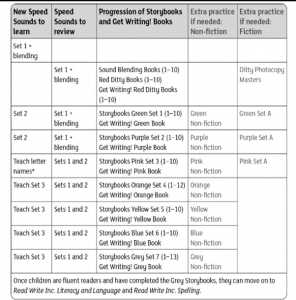
Children in school formally begin their RWI journey in the second week of FS2 and depending on ability, will generally complete the programme in the first term of Year 2. They are assessed half-termly and regrouped according to their phonic knowledge. They move through 3 sets of sounds, each with corresponding reading books.
Frequency of sessions
R.W.I sessions are expected to occur every day, as the continuity and pace of the programme is key to accelerating the progress of children’s reading development.
Speed Sound Sessions
Each RWI lesson begins with a Speed Sound Session. The purpose of this session is to learn to read and write sounds so they can read and spell words containing these sounds. Children progress through 3 sets of sounds throughout the programme and are regrouped based on regular assessments.
There is lots of information and some useful video clips for parents at:
http://www.ruthmiskin.com/en/read-write-inc-programmes/phonics