
“If you don’t like to read, you haven’t found the right book.” – J.K. Rowling
Reading Lead- Mrs Fleming
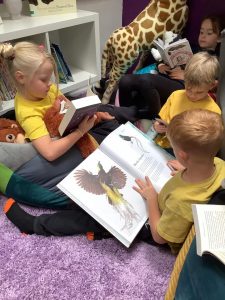
At St Joseph’s Primary, we are passionate about ensuring all children become confident
and enthusiastic readers and communicators, irrespective of their starting point. We
believe these fundamental skills not only hold the key to unlocking rest of the
curriculum, but also have a huge impact on children’s self-esteem and future life
chances. Stories are the beating heart of our curriculum and we strive to ensure all
children leave St Joseph’s with a love of reading.
At St Joseph’s, we believe that our classrooms should be language rich environments where talk and comprehension skills are planned for. We provide a range of opportunities throughout the day for back and forth talk between children and adults and also between children and their peers. Developing children’s language takes careful and deliberate planning which is why we have mapped out intentional vocabulary from Little Joeys to Year 6.
Reading at home
At St Joseph’s, we work in partnership with parents, so pupils develop a love of books
and reading. Daily reading at home, and at school, ensures children make good
progress in developing reading skills, whatever their age. Encouraging children to read
widely, in and out of school, across both fiction and non-fiction, helps to develop their
knowledge of themselves and the world in which they live; to establish an appreciation
and love of reading; and to gain knowledge across the curriculum. Reading widely and
often increases pupils’ vocabulary because they encounter words they would rarely
hear or use in everyday speech. Children in EYFS and KS1 take home daily a book
matched to their phonic ability. They also take home a book for pleasure from their
class library.
Children who have completed their Phonics are supported by their teacher, in choosing
a book to take home to enjoy. We encourage children to explore a range of texts
comprising of novels and picture books, both fiction and non-fiction. Children are also
encouraged to check out books from the library.
Promoting Reading
Reading is the key to unlocking the curriculum and we are committed that children at St
Joseph’s share a love of reading. Children who read for pleasure gain a richer
vocabulary, more knowledge, critical thinking skills and become independent learners.
As well as this, research also suggests that reading helps to improve the mental well-
being of children. Put simply, children who read a lot tend to be happier! It has also
been proven that children who are fluent readers tend to do better in their adult lives.
Reading at St Joseph’s is promoted as an enjoyable and enriching experience to both
children and parents via a wide range of activities:
Daily Reading Pledge – we ensure that all pupils are read to everyday by our
teaching staff. This time is highly valued and protected.
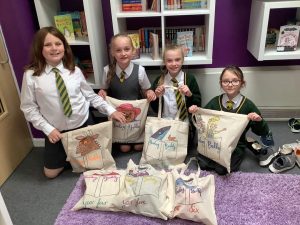
Reading Buddy Bags – Every Friday, a super reader is chosen to take a reading
buddy bag home. The children receive a hot chocolate and a book to enjoy with
their reading buddy!
Author visits – We regularly welcome visits from authors who talk to our
children about their books and reading in general. This helps to promote the
importance of reading and the pleasure that can be gained from reading.
World Book Day – We are committed to supporting World Book Day every year
and arrange a wide range of activities for our pupils to celebrate reading. This is
heavily promoted around our school in many of our vibrant displays.
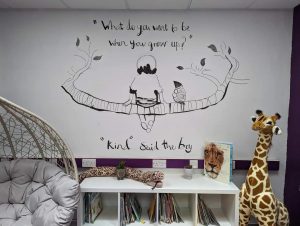
Library – We recently raised over £3000 to revamp our library. We now having a
well-stocked beautiful space to enjoy reading. Our newly appointed librarians
run a weekly book club and lending library.
High Quality Texts – we use high quality texts to deliver our English curriculum,
We provide children with rich reading experiences within the English lessons and
encourage them to appreciate the author’s use of language and writing
techniques in order to develop their own writing skills
Book Clubs – as part of our commitment to extra-curricular activities, we have
book clubs available to our pupils. This is an opportunity to share a high-quality
text and to talk about it with their peers.
Reading Corners – every classroom has a reading corner or ‘book nook’ to
promote and value the importance of reading.
Book Bus/Book Fairs – we regularly welcome the Scholastic’s Book Bus to
school, so that parents and children can buy books which in turn raises funds for
our school to help restock class and the school libraries.
Reading in EYFS
Area of Learning – Communication and Language
The development of children’s spoken language underpins all seven areas of learning
and development. Children’s back-and-forth interactions from an early age form the
foundations for language and cognitive development. The number and quality of the
conversations they have with adults and peers throughout the day in a language-rich
environment is crucial. By commenting on what children are interested in or doing, and
echoing back what they say with new vocabulary added, practitioners will build
children’s language effectively. Reading frequently to children, and engaging them
actively in stories, non-fiction, rhymes and poems, and then providing them with
extensive opportunities to use and embed new words in a range of contexts, will give
children the opportunity to thrive. Through conversation, story-telling and role play,
where children share their ideas with support and modelling from their teacher, and
sensitive questioning that invites them to elaborate, children become comfortable using
a rich range of vocabulary and language structures (Statutory Framework for the EYFS
2021)
At St Joseph’s we…
● Encourage our children to be confident and fluent speakers, where everyone feels
listened too. We encourage children to share their independent learning from the areas
at the end of sessions to develop their speaking and listening skills.
●Send home reading buddy bags with the children for the weekend. The child is
encouraged to share their adventure with their reading buddy to the rest of the class.
● Develop children’s communication skills by giving the children the opportunity to
listen to lots of stories, as well as providing opportunities to listen and join in with
singing songs and rhymes.
● Adults in the setting will model appropriate language within all areas and play
alongside the children within the setting in order to promote, scaffold, question and
support, develop and extend their use of language.
● In FS1 and FS2 children partake in Talk Boost sessions with selected children to
enhance and develop their take turning and listening and speaking skills.
Area of Learning Literacy – Reading
It is crucial for children to develop a life-long love of reading. Reading consists of two
dimensions: language comprehension and word reading. Language comprehension
(necessary for both reading and writing) starts from birth. It only develops when adults
talk with children about the world around them and the books (stories and non- fiction)
they read with them, and enjoy rhymes, poems and songs together. Skilled word
reading, taught later, involves both the speedy working out of the pronunciation of
unfamiliar printed words (decoding) and the speedy recognition of familiar printed
words. Writing involves transcription (spelling and handwriting) and composition
(articulating ideas and structuring them in speech, before writing). (Statutory
Framework for the EYFS 2021).
At St Joseph’s we…
● Deliver daily, planned opportunities to listen carefully and talk extensively about what
children hear, see and do in FS1 and Little Joeys.
● Deliver daily RWI lessons in FS2.
● Offer Talk Boost as an intervention for those children who have a delayed language to
help boost their language skills and narrow the gap between them and their peers.
● Offer daily story sessions, where identified texts/ poems are read with the children
and children are actively encouraged to take part in quality rich discussions around the
text/ poem.
● Have daily sessions where identified nursery rhymes, number songs and seasonal
songs are taught to the children.
● Expose our FS2 children to a wide range of texts within areas of the classroom to
enhance their learning and to give books a real purpose.
● Have an identified area in classrooms where books are displayed so that children can
develop a love of reading and have the opportunity to read for pleasure.
● Encourage all of our children to take a book home from our reading area on a daily
basis to share and enjoy with a parent/ carer at home. In FS2, children will also take
home a RWI book to support their RWI sessions in school.
● Visit our local library every half term so that children have the opportunity to read a
wide range of texts.
● Encourage parents/ grandparents to attend stay and read sessions where they can
share and read their favourite stories.
● Use rewards such as stickers, certificates, MM’s, reading displays to promote a love of
reading.
Reading in Key Stage 1 and 2
CUSP
At St Joseph’s, in Key Stage 1 and 2, we teach Reading using ‘Curriculum by Unity
Partnership’ (CUSP). CUSP is an evidence-informed, sequenced curriculum, which
provides a cohesive approach to the teaching of Reading from Year 1 up to Year 6.
There is a principle focus on fluency and vocabulary; teaching children the skills and
strategies they need, not only to access the Reading curriculum, but so they can also
apply these skills in a range of contexts to access the whole primary curriculum, and
onwards. This is achieved through a diverse range of literature (see our literature spine),
including whole novels, picture books, poetry and specifically written extracts so that
children are exposed to a wide range of different texts. These have been carefully
selected so that all children are exposed to a range of high-quality literature that ‘gives
every child a mirror in which to see themselves and offers a window to children to see a
world beyond their own’
CUSP Reading is deliberately designed to be ambitious and aspirational, ensuring that
every child leaves our school as a competent, confident reader. Drawing on the latest
research around explicit vocabulary instruction, automaticity and key comprehension
strategies, this curriculum is a synthesis of what we know works in helping children
make outstanding progress in reading and a distillation into consistent, well-structured
practice.
Pupils will receive a daily diet of excellent reading teaching and this will be
supplemented by regular opportunities to engage with shared reading experiences,
promoting the joy of reading with the whole school community. The clear structure and
principles ensure that teaching is progressive, challenging and engaging and the rich,
diverse literature spine acts as both a mirror so that every child can see themselves in
the core texts and as a mirror to engage pupils with experiences beyond their own field
of reference.